
Launching several new products at once feels efficient. One big push, instead of trickling products out one at a time.
But launching fast can create a problem that shows up somewhere you would not expect. Low reviews raising your Amazon PPC cost is a common, and often missed, cause of a rough launch.
The Launch
A seller launched six new products in a single month on Amazon UK. That is a lot of new listings going live at once. Each one needed its own ad campaigns, its own visibility, and its own momentum.
The ad campaigns themselves were reasonably well set up. Clicks were coming in. On the surface, that is exactly what you want from a launch. But cost per sale kept rising. The seller was paying more in ad spend for every unit sold, without any obvious change in how the ads were targeted.
Why the Ads Were Not Actually the Problem
It is tempting when cost per sale rises, to assume the campaign itself is broken. Wrong keywords, wrong bids, wrong audience. Here, that was not it.
A brand new listing usually launches with zero reviews, or very close to it. When a shopper clicks an ad and lands on a page with no reviews, nothing tells them the product is trustworthy.
It is like “walking into a shop with no other customers inside and no receipts in the bin.” Nothing is necessarily wrong. There is just no proof yet that anyone else has trusted the place.
Even if the product is good, the shopper has no way to know that yet. Many leave without buying. Not because the ad brought in the wrong person, but because the page gave them no reason to feel safe buying.

How This Pushes Ad Costs Up
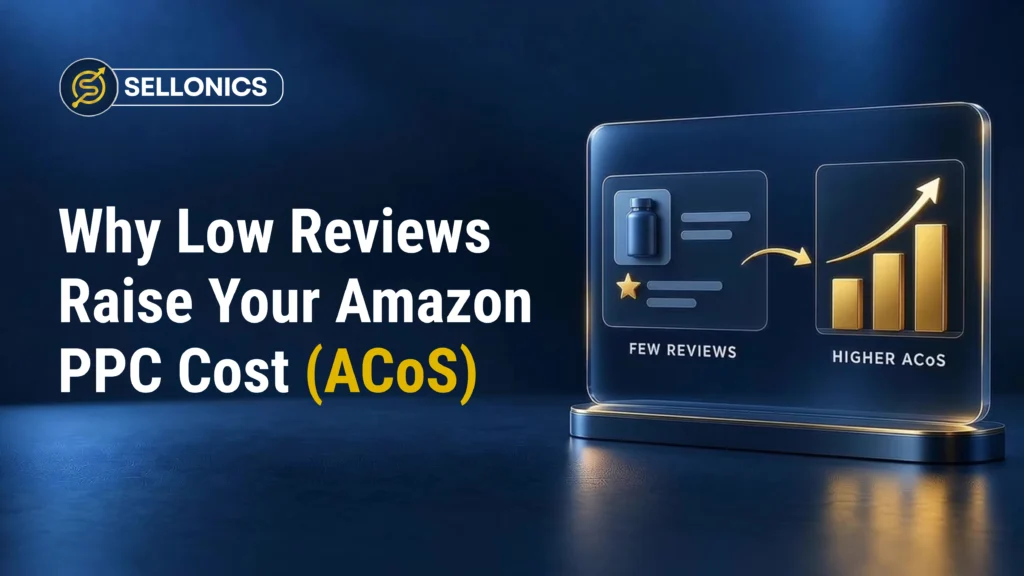
This matters for ad costs because of simple maths. If a campaign needs 100 clicks to generate one sale on an established listing with plenty of reviews, the math looks very different for a new one. A brand new listing with no reviews might need 200 or 300 clicks to get that same one sale. You pay for every one of those clicks.
More clicks needed per sale means a higher cost per sale. Even with identical targeting, identical bids, and identical keywords.

A Simple Way to See the Gap
| Listing type | Clicks typically needed per sale | Effect on cost per sale |
|---|---|---|
| Established listing with reviews | Around 100 | Baseline cost per sale |
| Brand new listing, no reviews | 200 to 300 | Two to three times the cost per sale, with identical ads |
So the ad account can look like it is underperforming, when really it is compensating for a trust gap that has nothing to do with the ads themselves.
What This Means for a Multi Product Launch
Launching several products in one go multiplies this effect. Every single one of them is starting from zero reviews at the same time. There is no established listing in the group to lean on while trust builds elsewhere.
Why Staggering a Launch Can Help
- One proven listing can support the brand while the others build trust
- Ad budget is not stretched thin across several zero review pages at once
- Lessons from the first launch, pricing, imagery, keywords, can improve the next one
A staggered launch is not always possible, but it is worth weighing against the appeal of launching everything together.
What To Do Before and During the Launch
It is worth expecting this in advance, rather than reacting to it after the fact.
- Budget for a higher cost per sale early on. Treat the first few weeks as a known cost of building trust, not a sign something has gone wrong.
- Start building reviews from day one. Use Amazon’s own approved tools alongside the ad campaigns rather than after them.
- Track cost per sale against review count. Watch for the point where cost per sale starts to fall as reviews build.
- Avoid pausing ads too early. Cutting spend before trust builds can stall the whole launch rather than fix it.
Our post on how to get more Amazon reviews safely covers the exact, rule following way to build that trust without risking your account.
Signs To Know the Reviews Problem
- Cost per sale is high only on recently launched products, not your whole account
- Click through rate looks normal, but conversion rate is low
- The listings in question have few or no reviews
- Cost per sale starts falling on its own as reviews slowly build
If this pattern matches what you are seeing, changing keywords or bids is unlikely to fix it on its own.
Frequently Asked Questions
- How long does it take for ACoS to improve after launch?
It varies by category and price point, but many sellers see a noticeable improvement once a listing reaches around 10 to 30 reviews and some sales history. - Should I lower my ad spend if cost per sale is high after launch?
Not immediately. Cutting spend too early can slow down the very reviews and sales history that would bring cost per sale back down. - Is it better to launch products one at a time instead of together?
Often, yes. Staggering launches means your budget and attention are not split across several zero review listings at once, and lessons from the first launch can improve the next. - Can a high launch ACoS still be worth it?
Yes, if it is treated as a planned cost of building trust rather than a sign of a broken campaign. Many sellers set a deliberately higher target ACoS for the first few weeks of a launch. - Does Amazon Vine help with this specific problem?
It can. Vine provides early reviews for eligible products, which can shorten the period where a listing is paying the highest cost per sale due to having no reviews yet.
Key Takeaway
Rising ad costs right after a launch do not always mean the ads are wrong. Sometimes the real gap is trust. Thin reviews making shoppers hesitate after they have already clicked.
Fixing that gap, not just tweaking the campaign, is often what actually brings the cost per sale back down. As the saying goes, “you cannot advertise your way out of an empty shop window.”
Book A Call
We manage Amazon complexity, so you can focus on scaling
Built for brands that want predictable Amazon performance without micromanaging every detail.
Real growth. Backed by real numbers.