
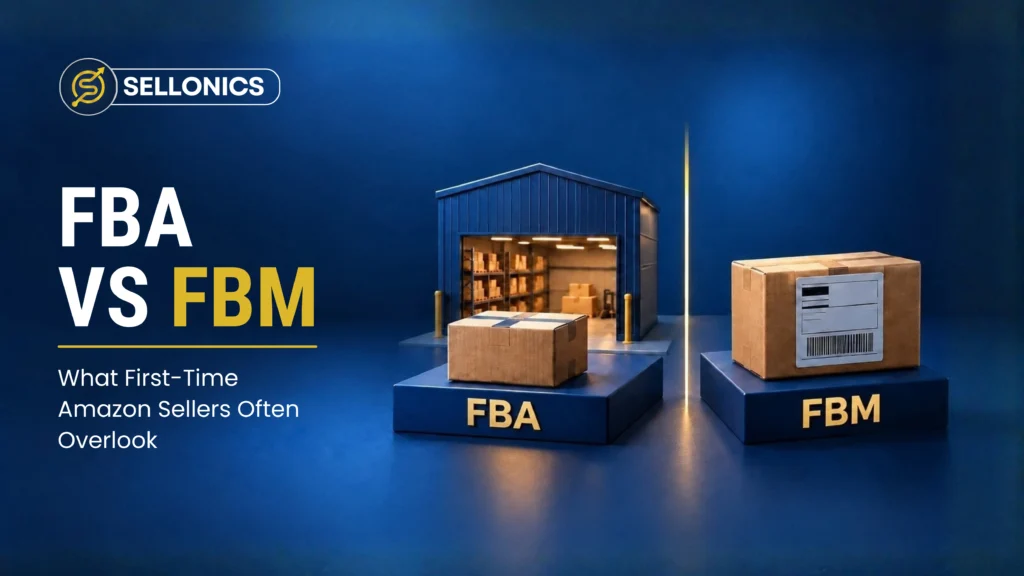

A distributor was expanding onto a new Amazon marketplace. They faced a choice most first time sellers do not think through properly. FBA vs FBM for first time sellers is not a question with one right answer.
Both options get your product from your warehouse to the customer’s door. But sellers often skip the real tradeoffs and just pick whichever option sounds easier.
What FBA and FBM Actually Mean
FBA stands for Fulfilled by Amazon. You send your stock to Amazon’s warehouses. Amazon takes it from there.
Amazon stores the stock. They pick and pack orders. They ship them and handle most returns. In exchange, you pay Amazon fees for storage and fulfillment.
FBM stands for Fulfilled by Merchant. You keep the stock yourself. When an order comes in, you or your team pick it, pack it, and ship it. Amazon is not involved in the physical delivery at all.

The Tradeoffs That Actually Matter
Three things decide which option fits your product. They do not work alone. You need to look at all three together.
| Factor | FBA | FBM |
|---|---|---|
| Speed | Fast delivery through Amazon. Often Prime eligible | Possible, but needs a strong setup to match |
| Cost | Storage and fulfilment fees that rise with size and slow sales | No Amazon fees, but you pay for your own warehouse and staff |
| Control | Amazon handles packing, shipping and most returns | You control every step, for better or worse |
Speed
Speed is usually the first thing people think about. Amazon’s network is built for fast delivery. FBA products often qualify for Prime, and many shoppers trust or look for that badge.
It is a bit like “choosing between a courier firm with its own vans or hiring your own driver.” One is ready to go today. The other can match it, but only once it is set up properly.
You can match that speed with your own fulfillment too. It just takes a serious, well run operation.
Cost
Cost works the other way round. FBA fees cover storage and fulfillment. They add up fast for products that are bulky, heavy, or slow to sell.
FBM avoids those specific fees. But you pay for your own warehouse space, staff, and shipping instead. The cost does not disappear. It just moves somewhere else.
Control
With FBA, Amazon handles the packing, shipping, and most of the customer service around delivery and returns. That is convenient.
But it also means you do not control how carefully your product gets packed, or how a return is handled.
With FBM, you control every step yourself. That can work for you or against you, depending on how good your own operation is.
Why This Decision Needs Real Numbers
Many first time sellers pick FBA by default. It sounds more professional. Others pick FBM because it feels cheaper on paper. Neither instinct is reliable. You need to check your actual numbers first.
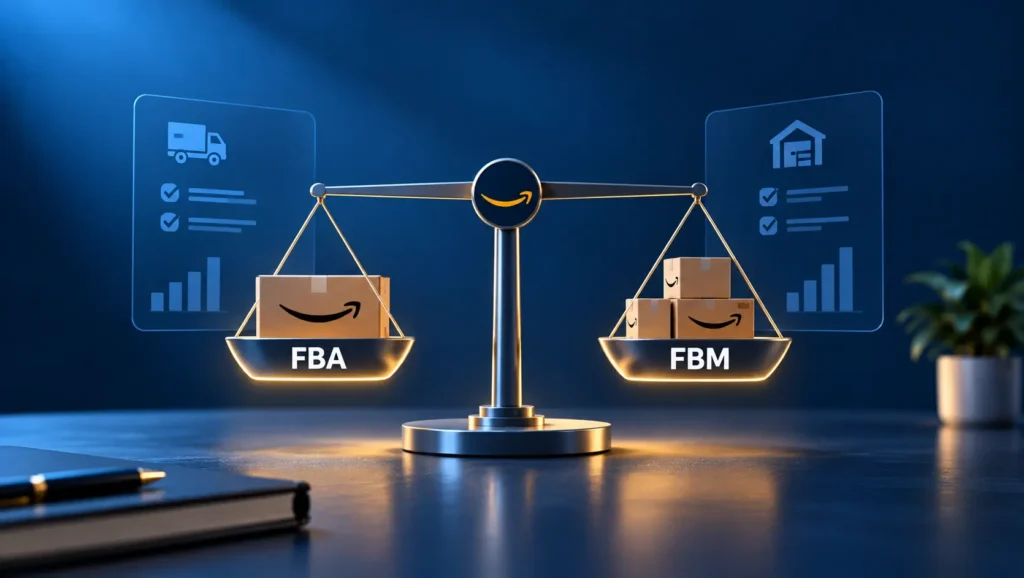
The right choice depends on your own business. Work through these points before you decide.
- Margin per unit. How much do you have left after fees on each option?
- Size and weight. Bulky or heavy products cost more to store and ship through FBA.
- Turnover speed. Slow moving stock in Amazon’s warehouses adds long term storage fees.
- Your current setup. Do you already have a working warehouse and shipping process, or would FBM mean building one from scratch?
- Realistic shipping speed. Can you match Amazon’s network, or would FBM customers wait longer?
Two Quick Examples
- A high margin, compact, fast moving product might do well on FBA, even with the fees
- A bulky, low margin product with slow sales might lose too much to FBA storage fees. FBM could work much better here
Neither example is a fixed rule. They just show how the same decision can go two different ways, depending on the product.
A Simple Way to Compare Your Own Numbers
You do not need complex software to start. A short spreadsheet is enough.
- List your cost price and selling price. This gives you your starting margin, before any fees.
- Add Amazon’s FBA fees. Use Amazon’s fee calculator to get figures for your product’s size and weight.
- Add your real FBM costs. Include packaging, staff time, shipping, and any software you would need.
- Compare the margin left on each side. The bigger number is not always the right answer, once you factor in speed and control.
If you are new to selling on Amazon, our Amazon PPC guide for beginners covers the basics of getting a new listing, once your fulfillment method is set.
When a Hybrid Setup Makes Sense
Some sellers do not pick one option for their whole catalogue. A mixed approach can work well, once you have real numbers for each product.
- Fast moving, compact bestsellers go on FBA to win Prime eligibility
- Bulky, slow moving, or high margin items stay on FBM to avoid storage fees
- New products sometimes start on FBM while you test demand, then move to FBA once volume justifies it
This only works if you check the numbers for each product. A single blanket decision for the whole account will not work as well.
Mistakes That Skew the Comparison
A few common errors can make FBA or FBM look better than it really is. Watch for these when you run your own numbers.
- Leaving out long term storage fees for slow moving FBA stock
- Forgetting staff time when costing FBM, not just packaging and postage
- Comparing list price fees instead of your actual size tier and weight
- Assuming FBM delivery speed without testing it on a real order
Any one of these can flip the result in favour of the wrong option. A short trial run with real orders tells you more than a spreadsheet estimate alone.
Key Takeaway
FBA and FBM are not a question. They are a tradeoff between cost, control, and speed. The right fit depends on your product and your setup.
Picking FBA or FBM on instinct is a bit like “choosing a removal company by how shiny their van looks.” It tells you nothing about whether it actually fits the job.
Before choosing either one for a new marketplace, work out your real numbers on both sides. The right answer is rarely obvious just from how each option sounds.
Frequently Asked Questions
Is FBA always better for first time sellers?
No, not always. FBA suits fast moving, compact products with enough margin to cover storage and fulfillment fees. A bulky or slow moving product can lose more to fees than it gains in speed.
Can I switch from FBM to FBA later, or the other way round?
Yes. Many sellers start on one option and switch once they have real sales data. The switch is simple, but check your stock levels and listing settings first.
Does FBA always mean faster delivery than FBM?
Usually, but not always. A seller with a strong warehouse close to major carriers can match FBA speed on some routes. For most sellers without that setup, FBA is faster.
What hidden FBA fees catch new sellers out most often?
Long term storage fees are the most common. These apply once stock sits in an Amazon warehouse too long. They can quietly wipe out the margin on slow moving products.
Is a hybrid FBA and FBM setup harder to manage?
It takes more ongoing work, since you need to check the numbers for each product. For sellers with a varied catalogue, it is usually worth the extra effort.
Book A Call

We manage Amazon complexity, so you can focus on scaling
Built for brands that want predictable Amazon performance without micromanaging every detail.
Real growth. Backed by real numbers.